.jpg)

Plan Educational Tours With Confidence
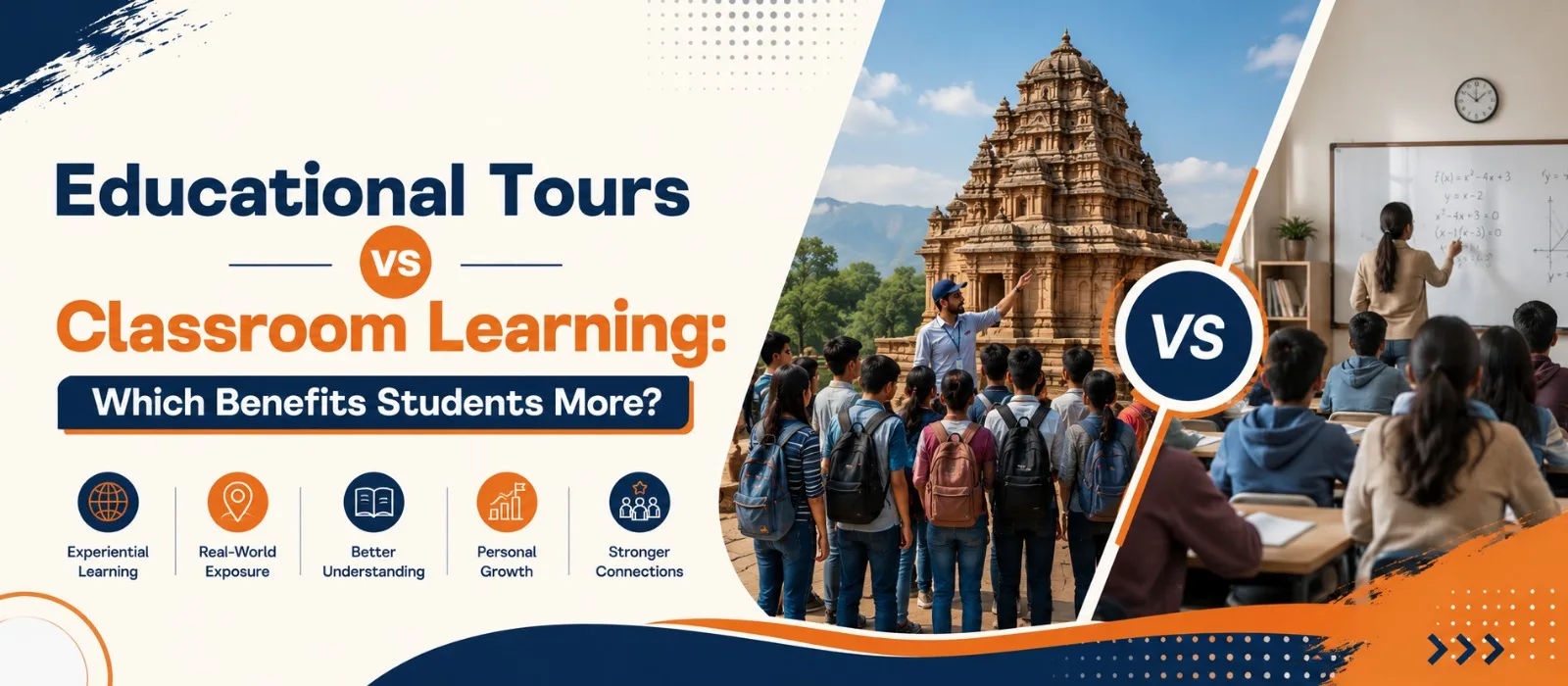
Can students truly understand a concept by simply reading about it in a textbook? Books and classroom lessons provide essential knowledge, but real-world experiences often create a deeper connection with what students learn.
For many years, classroom learning has been the foundation of education. It helps students develop subject knowledge, understand theories, improve academic skills, and learn under the guidance of teachers. A structured classroom environment allows students to build a strong base in subjects such as science, mathematics, history, and languages.
However, modern education is not limited to textbooks and lectures. Today, students also need practical knowledge, creativity, communication skills, problem-solving abilities, and exposure to real-world situations. This is where educational tours become valuable. Educational tours do not replace classroom learning; instead, they enhance it by connecting theoretical concepts with practical experiences. When students see, explore, and interact with real environments, they develop a better understanding of the topics they study.
For example, reading about a historical monument can help students learn facts and information, but visiting that place allows them to understand its architecture, culture, and historical importance in a more memorable way.
In this article, we will compare educational tours and classroom learning, explore the benefits of both approaches, and understand why combining classroom education with practical experiences creates a more effective learning environment for students.
Understanding Classroom Learning and Its Importance
Classroom learning is the most common and structured method of education, where students gain knowledge through lessons, discussions, assignments, and teacher guidance. It follows a planned curriculum that helps students learn concepts step by step.
Through classroom education, students develop a strong academic foundation. Teachers introduce basic concepts first and gradually help students understand more advanced topics. This systematic learning process prepares students for examinations, higher education, and future career opportunities.
Apart from academic knowledge, classrooms also help students develop important habits such as discipline, time management, responsibility, and regular study practices. The interaction between teachers and students creates an environment where learners can ask questions, clear doubts, and improve their understanding.
Although classroom learning mainly focuses on theoretical knowledge, it remains an essential part of education because practical experiences become more meaningful when students already have a basic understanding of the subject.
How Classroom Learning Helps Students Build Knowledge
Classroom learning provides students with a structured approach to understanding different subjects. Instead of learning information randomly, students follow a proper sequence where each concept builds on previous knowledge.
For example, before students understand advanced scientific processes, they first need to learn basic scientific principles. Similarly, before analysing historical events, they need to understand important background information.
Teachers play a major role in this process by explaining difficult topics, providing examples, correcting mistakes, and guiding students according to their learning needs. Regular classroom activities such as discussions, presentations, assignments, and projects also encourage students to improve their thinking abilities and communication skills.
Advantages of Classroom Learning
| ✓ Strong academic foundation: Students understand basic concepts that become the base for future studies and real-world learning. | ✓ Teacher guidance and support: Regular interaction helps teachers identify difficulties and motivate students to build confidence. |
| ✓ Discipline and study habits: Schedules, assignments and exam preparation build organisational skills. | ✓ Collaboration among students: Group discussions and team projects teach teamwork and communication. |
Limitations of Classroom Learning Without Practical Exposure
While classroom learning provides essential knowledge, depending only on traditional methods can create some limitations. One major challenge is the gap between theory and practical application. Students may understand concepts from textbooks but may find it difficult to connect those ideas with real-life situations.
For example, learning about environmental science from a book provides information, but visiting a natural environment helps students understand ecosystems more clearly. Another limitation is that students have different learning styles. Some students learn effectively through reading and lectures, while others understand concepts better through observation and hands-on activities. This is why practical experiences, such as educational tours, are becoming an important part of modern education.
What Are Educational Tours and Why Do They Matter?
Educational tours transform learning from a theoretical activity into an experience that students can remember for a long time. Unlike regular trips, these tours are designed with specific learning objectives to help students understand concepts beyond textbooks.
The main purpose of educational tours is not only to visit new places but also to help students observe, explore, and connect classroom knowledge with real-world situations. When students experience something personally, they often develop a stronger understanding of the topic. These experiences encourage curiosity, improve observation skills, and make learning more engaging.
Educational tours can include visits to historical monuments, museums, science centres, research institutions, industrial facilities, wildlife parks, agricultural farms and cultural locations. For example, students studying history can understand ancient architecture and cultural heritage by visiting historical places. Science students can learn about technology and innovation through research centres, while environmental studies students can understand ecosystems through nature-based visits.
Learning Beyond Textbooks
Textbooks provide important information and help students understand basic concepts. However, practical experiences make that knowledge more meaningful. A student can read about a manufacturing process in a book, but visiting an industry allows them to see how machines work, how products are created, and how professionals manage operations.
Similarly, reading about wildlife or ecosystems provides theoretical knowledge, but observing nature directly creates a deeper understanding. This connection between theory and practice helps students remember information for a longer period and encourages them to explore subjects with greater interest.
Different Types of Educational Tours
| ✓ Historical educational tours: Forts, museums, ancient monuments and heritage sites that build a stronger connection with history. | ✓ Science and technology tours: Science museums, research laboratories and technology centres that spark interest in innovation. |
| ✓ Industrial visits: Production processes, workplace systems and career exposure for senior students. | ✓ Environmental and nature-based tours: Forests, wildlife parks and ecological centres that teach conservation. |
Educational Tours vs Classroom Learning: A Complete Comparison
Educational tours and classroom learning both play an important role in student development. Classroom education focuses on building theoretical knowledge, while educational tours help students apply that knowledge in practical situations. Neither approach is better on its own. The most effective learning happens when students receive classroom instruction and practical exposure together.
| Learning Factor | Classroom Learning | Educational Tours |
|---|---|---|
| Learning Method | Textbooks, lectures, discussions, assignments and classroom activities | Observation, exploration, practical activities and real-world experiences |
| Learning Environment | Structured classroom with teacher guidance | Real-world locations such as museums, industries and historical sites |
| Main Purpose | Builds theoretical knowledge and academic concepts | Applies classroom knowledge to practical situations |
| Student Involvement | Listening, reading, writing, discussions and assignments | Observing, asking questions, exploring and interacting |
| Skills Developed | Subject knowledge, discipline, study habits and academic abilities | Confidence, communication, teamwork, leadership and problem-solving |
| Teacher's Role | Explains concepts, clears doubts and provides academic guidance | Helps students connect practical experiences with classroom lessons |
1. Theory-Based Learning vs Practical Understanding
Classroom learning provides the theoretical foundation through books, lessons and discussions. Educational tours allow students to see how those concepts work in real situations. For example, students can learn about ecosystems in biology class, but visiting a wildlife sanctuary or botanical garden helps them observe plants, animals and environmental relationships directly.
2. Passive Learning vs Active Participation
Traditional classroom learning often involves listening to lectures, taking notes, completing assignments and preparing for exams. Educational tours encourage active participation through observation and hands-on experiences, where students can ask questions, interact with experts, explore new environments and participate in activities.
3. Classroom Discipline vs Real-World Exposure
Classroom learning helps students develop discipline through schedules, rules, assignments and academic routines. Educational tours expose students to situations outside their regular environment where they learn adaptability, communication, teamwork and problem-solving.
4. Academic Knowledge vs Life Skills Development
Classroom learning develops academic knowledge, while educational tours help students develop important life skills such as communication, leadership, teamwork, decision-making, time management and social interaction, which are difficult to develop only through textbooks.
5. Short-Term Learning vs Long-Term Memory
Educational tours often create stronger memories because students experience concepts directly. Information learned only for exams may be forgotten over time, but experiences connected with emotions and real situations often remain for years.
Benefits of Educational Tours for Students
Practical learning experiences provide benefits that go beyond academic learning. They help students develop knowledge, confidence, creativity and practical skills that support their overall growth.
| ✓ Better understanding of academic concepts: Practical exposure helps students connect classroom lessons with actual situations. | ✓ Encourages curiosity and independent thinking: Students explore new places and naturally ask deeper questions. |
| ✓ Improves confidence and communication skills: Interacting with guides and professionals helps shy students open up. | ✓ Develops teamwork and leadership skills: Group activities teach cooperation, responsibility and team management. |
| ✓ Provides career awareness: Exposure to industries, research facilities and technology centres helps students plan their future. |
Why Experiential Learning Is Becoming Important
The modern world requires students to develop skills beyond academic knowledge. Today, students need creativity, problem-solving abilities, communication skills and the ability to adapt to new situations.
Experiential learning focuses on learning through observation, participation and real experiences rather than only memorising information. Field-based learning experiences are one of the best examples of experiential learning because they allow students to actively participate in the learning process. Instead of only reading about a concept, students can see it, experience it, and understand how it works in real life.
How Educational Tours and Classroom Learning Work Together
The best education system does not choose between classroom learning and educational tours. Instead, it combines both approaches. Classroom learning provides the foundation by introducing concepts, theories and important information. Practical learning activities then help students apply and understand those concepts through real-world experiences.
For example, a history lesson can be followed by a visit to a heritage site, a science chapter can be supported by a visit to a science centre or research facility, and an environmental lesson can be enhanced through a nature-based educational trip. This combination creates a complete learning experience where students first understand ideas and then see their practical applications.
How Schools Can Create Effective Educational Tour Experiences
A successful educational tour requires proper planning and organisation. Schools should focus on creating experiences that are safe, meaningful and connected with learning objectives.
| ✓ Selecting the right destination: Choose places that provide valuable learning opportunities, not only entertainment. | ✓ Preparing students before the tour: Explain what students will observe, learn and question before travelling. |
| ✓ Connecting the tour with classroom lessons: Follow up with discussions, presentations, projects and assignments. | ✓ Ensuring safety and proper management: Focus on safe transportation, supervision, emergency planning and coordination. |
Why Schools Choose Professional Educational Tour Planning
Organising an educational trip requires proper experience, planning and coordination. Schools need support with destination selection, transportation arrangements, scheduling, safety planning, educational activities and student management.
A professional educational tour partner helps schools create organised and meaningful learning experiences. The purpose of an educational tour should not only be visiting a place but creating an opportunity where students learn, explore and develop new skills.
Educational Tours and the Future of Student Learning
The future of education is moving towards more interactive and experience-based learning. Technology has changed how students access information; today, students can learn through online resources, digital platforms and virtual tools. However, real-world experiences continue to have a unique importance.
A student can watch a video about a place, but visiting that place creates a stronger emotional and practical connection. Educational tours will continue to play an important role because they combine knowledge with exploration and help students understand the world beyond classrooms.
Why Choose Edutour for Educational Tours?
At Edutour, we believe learning should go beyond the classroom. As a trusted educational tour provider, we design safe, well-organized, and curriculum-focused tours that help students connect classroom knowledge with real-world experiences. From historical sites and science centers to industrial visits and nature excursions, our educational tours inspire curiosity, build confidence, and create unforgettable learning experiences for every student.
Why Schools Choose Edutour:
| ✓ Curriculum-aligned educational tour programs | ✓ Safe, secure, and professionally managed travel |
| ✓ Customized itineraries for schools and colleges | ✓ Experienced tour coordinators and on-ground support |
| ✓ Interactive learning experiences at educational destinations | ✓ Comfortable transportation, accommodation, and meal arrangements |
| ✓ Affordable packages tailored to your institution's requirements |
Partner with Edutour today and give your students the opportunity to learn, explore, and grow through meaningful educational travel experiences. Contact us now to plan your next educational tour!
Conclusion
The comparison between educational tours and classroom learning shows that both approaches are essential for complete student development. Classroom learning provides students with academic knowledge, theoretical understanding, and teacher guidance. Educational tours add practical exposure, confidence, creativity, and real-world skills that cannot be developed through textbooks alone.
The most effective learning environment is created when schools combine classroom education with experiential learning. When students understand concepts in classrooms and apply them in real situations, learning becomes more meaningful, engaging, and long-lasting.
Ready to Plan an Educational Tour?
Help your students connect classroom learning with real-world experiences. Get in touch with our group tours team today to plan a customized educational tour that combines learning, exploration, and fun.
FAQ's
Q1. Are educational tours better than classroom learning?
Educational tours cannot replace classroom learning because students need theoretical knowledge and teacher guidance. However, they make education more effective by providing practical exposure.
Q2. Why are educational tours important for students?
Educational tours help students improve understanding, confidence, communication skills, teamwork, curiosity, and practical knowledge.
Q3. Can educational tours improve academic performance?
Yes, educational tours can improve learning outcomes because students understand concepts better when they experience them in real situations.
Q4. What is the difference between classroom learning and experiential learning?
Classroom learning focuses on gaining knowledge through lessons, books, and discussions, while experiential learning focuses on understanding concepts through practical experiences.
Q5. How do educational tours help in personality development?
Educational tours improve confidence, communication, teamwork, leadership abilities, and decision-making skills by exposing students to new environments.